Open to ML and AI roles in Dhaka

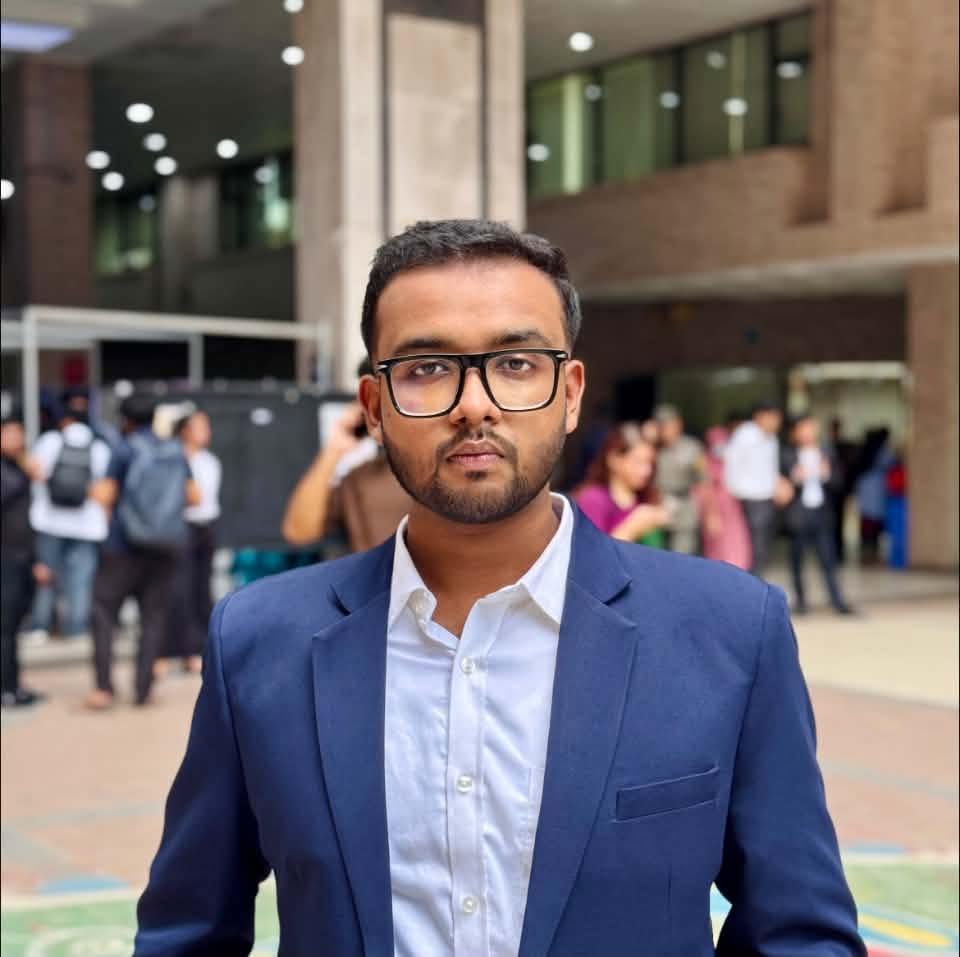
Jalal Abedin.ML Engineer& Researcher.

I'm most interested in the part of AI that people tend to skip: how it breaks. During my degree at North South University I attacked an image model, built an agent to defend it, and checked my results against human judgement instead of trusting a single metric. I want to build AI that holds up outside the lab.

Jalal Abedin
Marcus Aurelius.
What my final year project doesReal example from the project report
The user asked fora teddy bear by a pillow
Stable Diffusion drawswaiting for the prompt
0IEEE paper published
0model backbones benchmarked
0attacks evaluated by hand and by metric
0GPU hours of experiments

Two research projects, with the numbers and the limits.

Open a project to read the problem, how it was built, the results, and what didn't work.

Under review at IEEE AccessFederated learningComputer visionAudit ledger

ChainGuardFL: checking the data behind a federated model

In federated learning the server never sees what clients train on. This project screens every client's images for AI-generated fakes and duplicates before training starts, and records each decision in a ledger anyone can verify.

6.77accuracy points lost on average when fakes and duplicates got into the data
2.15points won back by the filter, for all 8 backbones
31.7%faster training rounds, since 37.1% of the images were removed
Clean data
61.9
Fakes mixed in
55.1
With filter
57.3
Centralized
67.0

Average test accuracy (%) over 8 backbones. Centralized figures come from an earlier benchmark on the same dataset.

Read the full case study
The problem

FedAvg assumes every image a client holds is real. Two things break that. A client's data can contain AI-generated artwork, by accident or on purpose. And the same painting can arrive through several clients at different sizes or formats, which quietly gives it extra weight. Afterwards, nobody but the server operator can check what was accepted or rejected.

How it works
  • Fake filter. A DaViT-Base real versus fake classifier scores each training image once, before round 1. Anything scoring above 0.5 is dropped.
  • Duplicate registry. Each image is converted to RGB, resized to 256 by 256 and hashed with SHA-256. The same artwork gives the same hash in any file format, so copies from other clients are rejected.
  • Training. 10 clients with uneven class splits (Dirichlet 0.5), 50 rounds of standard FedAvg on the verified data.
  • Ledger. Every verdict, update hash and global model hash goes into a SHA-256 chain, so editing an old record breaks every later one.

It adds a step in front of FedAvg and leaves the aggregation rule alone, so the checking cost is paid once instead of every round.

Results for each backbone (test accuracy, %)
BackboneCleanFakes mixedFilteredRecovered
Inception-ResNet-V254.4047.1650.88+3.72
ResNet-10156.3653.2354.03+0.80
ViT-B/1662.8255.7756.56+0.79
MaxViT-tiny59.6955.1956.56+1.37
MViTv2-tiny65.1759.3061.64+2.34
FocalNet-tiny65.9555.5858.32+2.74
DaViT-base66.5456.6758.71+2.04
RepViT-m363.9957.8461.27+3.43
Average61.8655.0957.25+2.15

The ordering fakes mixed, then filtered, then clean, then centralized held for every backbone. A model's centralized rank did not predict its federated rank: RepViT-m3 was fourth centrally and second after filtering.

How good is the filter?

On 7,575 training images it caught 1,965 of 2,407 fakes (81.6% recall) with 70.0% precision, and wrongly removed 843 real images.

What the numbers really say. The filter recovers about a third of the damage. The 9.73 point gap to centralized training is roughly 5.11 from federated training itself and 4.62 from fakes that got through. Part of the speed gain is simply less data.
Limitations
  • The filter runs once, so a weakness against a new image generator affects the whole run.
  • The ledger is a hash chain inside one process. It shows tampering but has no multi-node consensus.
  • Only pixel-identical copies are caught, not two photos of the same painting.
  • It checks data, not weight updates, so a poisoned update would pass.
  • Everything was tested at a single heterogeneity setting.
The audit ledger

Every integrity decision is written to a SHA-256 hash chain, so the whole training run can be checked afterwards. The chain is implemented in Python with hashlib and runs inside the training process. It is not Ethereum, Hyperledger or any public network, and the report says so openly: it proves that records were changed, but it has no independent validator nodes.

Each block stores its index, its payload, and the hash of the block before it. The block hash is SHA-256(index + payload + previous hash). Change any old record and every block after it stops matching.

The records above are illustrative. The hashing is real and runs in your browser.

What gets recorded
  • Filter verdicts: client, image pixel hash, DaViT score, kept or removed.
  • Duplicate registry: each registration, and each rejection with the original owner and timestamp.
  • Training: a hash of every client's weight update, and a hash of each global model.
  • Final certificate: written once all 50 rounds are done.
Where it connects to the pipeline

The ledger is written to at both stages. Before round 1, the filter and the registry log every verdict. Then in each round, every client update is hashed and logged before it reaches the server, and the new global model is hashed and logged after FedAvg. A live dashboard shows the latest block hash, the block count and whether the chain is valid.

Final year projectAdversarial MLDiffusion modelsLLM agents

POSAttack: tricking Stable Diffusion, then catching the trick

Eight extra words on a harmless prompt can make the model draw something else. I made that attack succeed more often, then built an agent that finds the injected words anywhere in a sentence and repairs the prompt.

1 to 5points higher attack success than the random-start baseline, in every word category
55%of 182 successful attacks undone by the agent, by automatic scoring
80%undone when four people judged the same images
Mahalanobis
40%
Agent, auto
55%
Agent, human
80%

Share of the 182 successful attacks that each defense reversed.

Read the full case study
The problem

Add a short run of odd tokens to "a little teddy bear sitting by a pillow" and the model draws the bear by a window. The sentence still reads the same, but its embedding has moved. Earlier work found nouns easy to attack and adverbs hard, yet started every search from random tokens and tested no defense.

The attack
  • Warm start. I searched about 49,000 CLIP tokens for the ones nearest the target word, dropped junk fragments, and ranked each by how far it pulls the sentence toward the target.
  • Crossover and mutation. The three best tokens are recombined into a ten-token starting suffix.
  • GCG search. The standard optimizer then runs 100 steps, five times per prompt, and each run is judged on seven images. Only the starting point changed.
Attack success rate, 600 prompt pairs per setting
Word typeBaselineMineBaseline, restrictedMine, restricted
Noun0.650.690.510.53
Proper noun0.400.450.310.33
Adjective0.290.300.240.25
Verb0.150.160.120.13
Numeral0.130.150.110.13
Adverb0.030.070.010.06
Why some words resist
  • Attention maps showed that only two or three suffix tokens do the work. For the target "gun", they were "revolver" and "scope".
  • With no attack at all, Stable Diffusion loses count past three and barely reacts to adverbs, so there is little signal to push on.
The defense
  • Perplexity filter. Weak, because many suffixes still read as plausible English.
  • Mahalanobis filter. Reversed 40% (72 of 182), but gives one score and no location.
  • CLIP-ReAct agent. A Llama-3.3-70B agent scans the sentence with a sliding CLIP anomaly tool, points at the injected span wherever it sits, and rewrites the prompt five different ways. It reversed 100 of 182 by automatic scoring.
The automatic score was too harsh. Four human evaluators marked about 80% as defended (145.5 of 182) and agreed with CLIP only 68.4% of the time. For nouns, reviewers also preferred the baseline's images even though my method scored higher, so a higher score doesn't always mean a better picture.
The tool around it

One attack takes about 40 minutes, so I built a Flask app with a live attack log, all three defenses and a results dashboard, plus an annotation tool for judging 1,200 images by hand.

Limitations
  • Only Stable Diffusion v1.5 was tested.
  • CLIP judges both the attack and the defense.
  • The defenses were tested only against this one attack.
  • The agent relies on a hosted model (Groq), which affects reproducibility.
My part: the CLIP-ReAct defense agent

I built the agent-based defense. It uses Llama-3.3-70B through the Groq API, and it was designed to fix a weakness in the two simpler filters: they give one score for the whole sentence and cannot say which words are the attack. My agent finds the injected words, wherever they are, and repairs the prompt.

ScanA tool slides a window of 1 to 4 words over the whole sentence and gives each span a CLIP anomaly score.
DecideThe agent reads the top 15 spans and points at the injected one. It may call the tool twice at most.
RepairFive fixes run on the flagged span: fuzzy removal, grammar repair, paraphrase, best cut by perplexity, plain rewrite.
CheckStable Diffusion draws 7 images per fix. If 4 match the original idea, the attack counts as defended.
How I built it
  • Anomaly score. One minus the CLIP similarity between a span and the rest of the sentence. A high score means the span doesn't belong.
  • Calibration. I took real injected spans by comparing each prompt with its attacked version word by word, and clean spans from random windows of normal prompts. Then I searched every threshold for the best F1 score and fixed it at 0.6204.
  • ReAct loop. The agent follows a Thought, Action, Observation cycle. It combines the score with its own reading of the sentence, because a rare but harmless word can also score high.
  • Safe failures. If the model's answer can't be read or the loop runs out, the sentence is treated as clean, so a bad response never stops the evaluation.
  • Five repair strategies. Three use the LLM and two don't. If an LLM call fails, that run falls back to fuzzy removal.
What it achieved

Of 182 successful attacks, the agent reversed 100 by automatic scoring (55%), against 40% for the Mahalanobis filter. It worked best on proper nouns (67%), adjectives (60%) and nouns (59%), and worst on adverbs, where it reversed none of the 7. Human reviewers later judged about 80% defended, which showed the automatic score was too strict.

What I built and measured
  • Perplexity filter. Threshold set at the 95th percentile of 600 clean prompts (283.46), plus a character-swap step based on SmoothLLM.
  • Mahalanobis filter. Sentence-BERT embeddings with a Ledoit-Wolf covariance fitted on about 120 unique clean prompts. It reversed 40% of the attacks.
  • CLIP-ReAct agent. The anomaly threshold (0.6204) was tuned for the best F1 score on real injected spans against clean ones. It reversed 55% by automatic scoring.
  • Human evaluation. Four evaluators reviewed the defense results. They judged about 80% defended, which showed that the automatic score undercounts.

More projects

Loading from GitHub

Published at IEEE ICIICE 2026

I presented this paper orally in Dubai. It tells real artwork from AI-generated artwork using vision transformers.

The same classifier became the fake filter inside ChainGuardFL, so the two projects are one line of work.

IEEE conference paper, 2026

Real and Fake Art Prediction Using Deep Learning

doi.org/10.1109/ICIICE69672.2026.11565256

Certificates

Click one to see the certificate.

Tools I use

Machine learning

PyTorchTensorFlowscikit-learnHugging FaceCLIPStable DiffusionSHAP

Research areas

Adversarial MLFederated learningComputer visionNLPLLM agents

Languages and tools

PythonSQLPHPGitColabKaggle

Shipping

FlaskStreamlitHF Spacesngrok
2022 to 2026

BSc in Computer Science and Engineering

North South University, Dhaka. Thesis (CSE498R) and senior design project (CSE499) in adversarial and federated machine learning.

Let's talk.

Hiring for an ML role, or working on something where models might fail? I answer every email.